

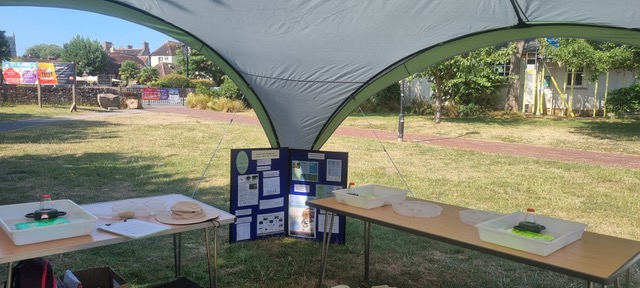
6 students and their teacher who runs the Eco-Club at Queen Elizabeth’s School in Wimborne, took part in a Riverfly Monitoring session on the River Allen at the Allendale café this week with volunteers from Rivers for Wimborne. The aim was to try and inspire young people to get involved in conservation and see how we monitor the health of rivers through this national scheme which is co-ordinated locally by Dorset Wildlife Trust.
Monitors sample the river once a month using a standardised method, then sort and count the invertebrates which gives a score for that sample. If this score is below a set ‘trigger level’ for that site or if the score changes dramatically, it will alert the monitors to an issue and they would contact the relevant authorities such as the Environment Agency to investigate fully.
The students learned about some of the stressors on some of our rivers in Dorset, of which there are over 1000k including some globally rare chalk streams such as the River Allen. Some of these include pollution from agricultural runoff, sewage, road run off historic altering the course of the river, biodiversity loss, invasive species and the influence of recreational activities, particularly the devastating effect that spot on treatment of dogs for fleas and ticks can have on the insect life in the river. As riverflies, such as mayflies, stoneflies and caddis flies are very sensitive to pollution, have a long lifecycle in the water and have limited mobility, they are very good indicators of river health – they are the ‘canaries’ of the river systems.
Having sampled the river, the students got stuck in to identifying and sorting the invertebrates into 8 different groups. They picked up how to identify the creatures very quickly and enthusiastically before adding up their counts and getting their score, which showed that the river here is in reasonable health now.
It is hoped that sessions like these will inspire younger people to get involved in these types of citizen science schemes such as riverfly monitoring, and the Water Guardian scheme, again co-ordinated by DWT, and is a monthly visual check of the river, and the Earthwatch Waterblitz scheme which is a biannual measure of nitrates and phosphates in the river.
Students all received a leaflet with hints and tips on how we can all take action to look after our rivers, and they were keen to share this information with other students in school.
The teacher Ms Leanord said
‘It was such an informative session, and the students had a fantastic time. They really enjoyed getting stuck into the river dipping and identifying the different invertebrates, and they were still talking about it on the way back to school! It was a brilliant opportunity for them to learn more about the health of our local rivers through such a hands-on experience.
Thank you again for such a wonderful experience. We would absolutely love to work with you again in the future.’
Rivers for Wimborne hope to do more sessions with schools to get our young people interested in looking after our rivers. For more information see the website www.wildingwimborne.org.uk or contact riversforwimborne@gmail,com